Admoon Marketing Website
Overview
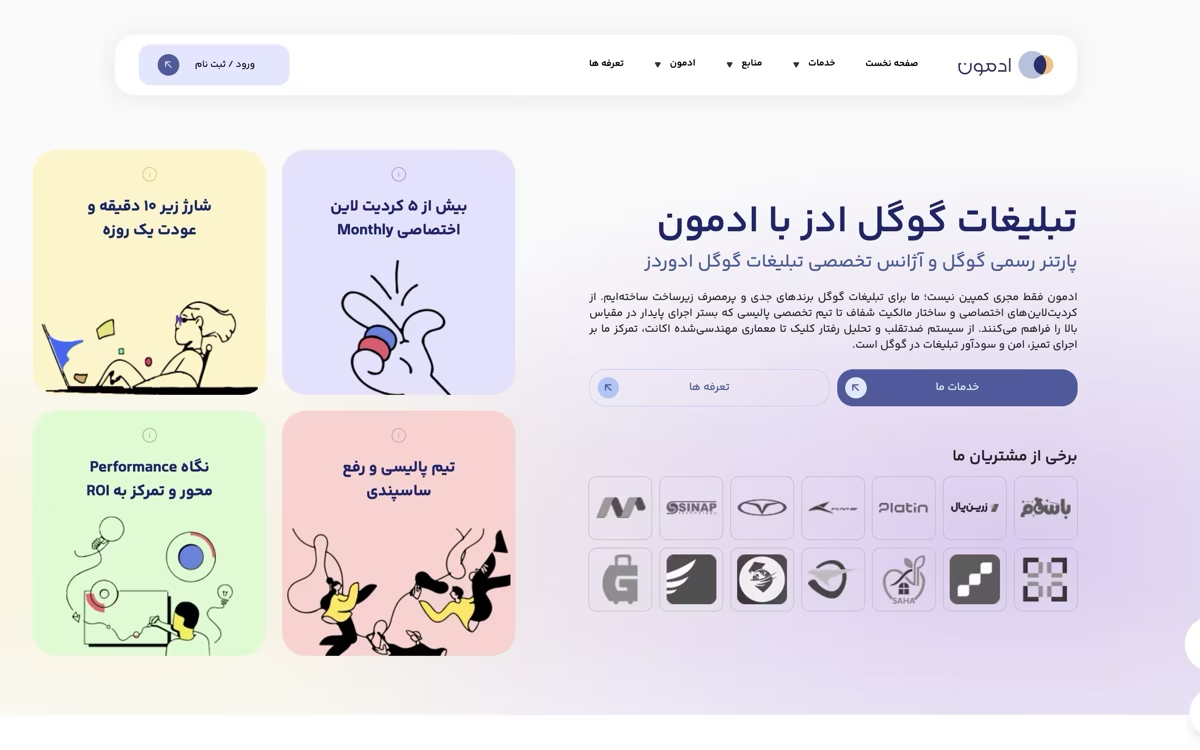
Admoon required an expansive, multi-page marketing platform with dozens of service landing pages, dynamic tariff calculators, and lead capture workflows. The primary engineering challenge was delivering rich interactivity and high Google search visibility without accumulating heavy client bundle bloat or degrading mobile performance.
Architected a high-performance Next.js App Router application leveraging Server-Side Rendering (SSR) for instant search engine indexing. Implemented a dynamic multi-currency pricing engine, responsive lead forms, optimized vector motion, and fluid mobile-first layouts with zero Cumulative Layout Shift (CLS 0.00).
Technical Bottlenecks & Architectural Constraints
Admoon required an expansive, multi-page marketing platform with dozens of service landing pages, dynamic tariff calculators, and lead capture workflows. The primary engineering challenge was delivering rich interactivity and high Google search visibility without accumulating heavy client bundle bloat or degrading mobile performance.
Core Implementation Hurdles & Engineering Solutions:
Real-Time Currency Conversion & Tariff Calculation Latency
Continuous slider adjustments and live conversions across USD, AED, and TRY could trigger unnecessary re-renders and input lag during rapid user interactions.
↳ Offloaded arithmetic calculations to memoized selector hooks and debounced slider event dispatches, achieving an ultra-fast 24ms INP.
60 FPS Cursor Tracking Across Multiple DOM Nodes
Simultaneously rotating 24 team avatar nodes based on cursor coordinates risked causing layout thrashing and frame drops on low-power devices.
↳ Applied hardware-accelerated CSS transform properties and throttled mousemove event listeners, guaranteeing a stable 60 FPS without CPU spikes.
Layout Shift Prevention Across Dynamic Media
Asynchronous loading of hero video assets and responsive service graphics risked causing Cumulative Layout Shift (CLS) during page hydration.
↳ Enforced strict CSS aspect-ratio constraints and reserved geometric containers across all breakpoints, achieving a verified 0.00 CLS.
Front-End Performance Budgets & Quality Gates
Interaction to Next Paint (INP)
Target Budget: < 200 ms
Audited in Chrome DevTools Performance panel: 2ms input delay, 0ms processing duration, and 22ms presentation delay on pointer interactions with zero main-thread blocking.
First Contentful Paint (FCP) / LCP
Target Budget: FCP < 1.0s / LCP < 2.5s
Verified via Google PageSpeed Insights. Next.js Server-Side Rendering delivers initial semantic HTML in 0.6s, with lightweight Rive assets keeping Total Blocking Time (TBT) at 160ms.
Cumulative Layout Shift (CLS)
Target Budget: < 0.05
Verified via Google PageSpeed Insights and Chrome DevTools. Enforced explicit aspect-ratio constraints on hero video banners and dynamic containers.
Interface & Architecture Showcase
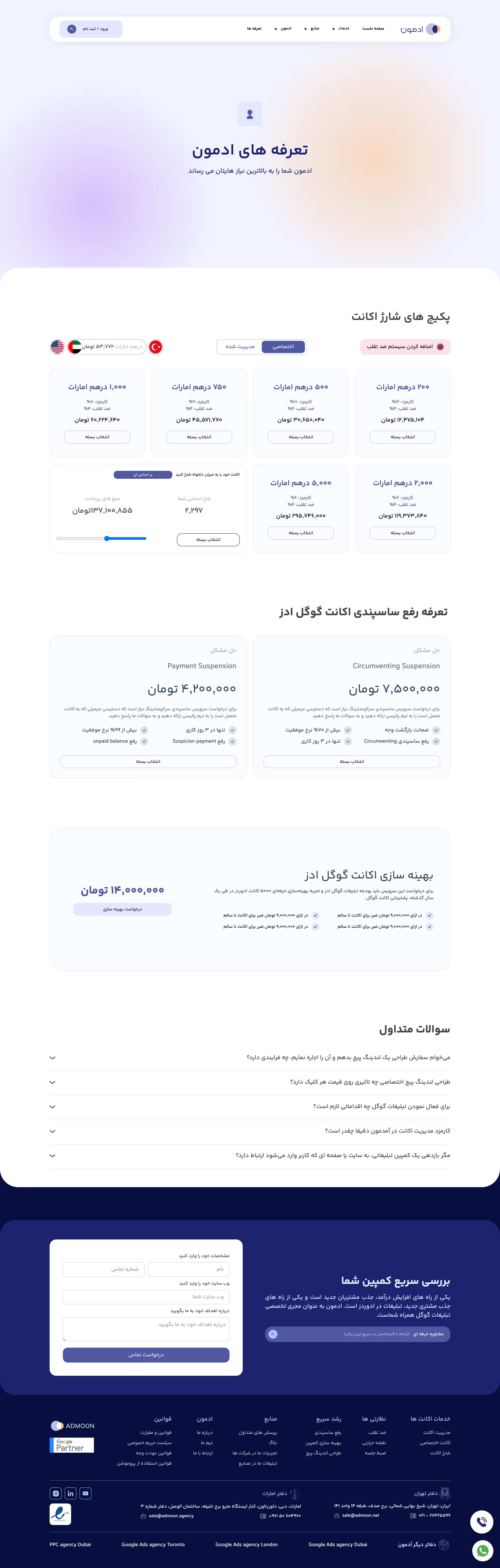
Multi-Page Marketing Architecture & Fluid Responsiveness
A modular page architecture using Next.js Server Components, ensuring fast initial delivery and consistent layout geometry across mobile, tablet, and desktop viewports.

Dynamic Google Ads Pricing & Tariff Calculator
A dedicated tariff calculator page featuring real-time exchange rates (USD, AED, TRY), tiered fee scales, and responsive sliders with debounced state dispatch for immediate feedback.
Interactive Team Grid with Real-Time Cursor Tracking
In this interactive section, every team member's portrait dynamically tracks and turns toward the user's active cursor position in real time. Built with pure, optimized front-end performance without heavy external physics libraries, sustaining a smooth 60 FPS.

Front-End Implementations & Core Highlights
Lightweight Vector Motion with Rive
Replaced heavy animated GIFs with lightweight vector Rive runtime animations, drastically reducing initial download payloads while maintaining sharp, 60 FPS visual motion on high-density displays.
- ▸Shrunk asset weights to a fraction of traditional GIF files
- ▸Preserved crisp vector clarity across all screen resolutions
- ▸Kept Total Blocking Time (TBT) low at 160ms
Interactive Lead Acquisition & Consultation Forms
Engineered multi-step lead capture workflows across marketing pages with client-side field validation, instant error handling, and friction-free state management.
- ▸Client-side schema validation without page reloads
- ▸Touch-friendly responsive form layouts across mobile and desktop
- ▸Optimized input handling contributing to sub-25ms interaction latency
Technical Trade-offs & Engineering Decisions
Every architectural choice balances runtime performance, team velocity, and production scale. Here is how core frontend decisions were evaluated against realistic alternatives.
Rendering Architecture: Server-Side Rendering (SSR) vs Client-Side SPA
Next.js App Router with Server-Side Rendering for all marketing routes
Pure Client-Side Single Page Application (SPA)
High-competition advertising keywords required instant HTML indexing by Google crawlers without waiting for client-side JavaScript execution. SSR delivered full semantic content on the initial request, achieving a 0.6s FCP.
Responsive Strategy: Fluid Mobile-First Layouts vs Separate Device Layouts
Unified Mobile-First Fluid Design with Tailwind CSS
Separate mobile subdomains or fixed desktop breakpoints
A disciplined mobile-first responsive architecture prevented layout fragmentation across varying device viewports and eliminated Cumulative Layout Shift (CLS 0.00) entirely across extensive multi-page layouts.
The Engineering Solution
Architected a high-performance Next.js App Router application leveraging Server-Side Rendering (SSR) for instant search engine indexing. Implemented a dynamic multi-currency pricing engine, responsive lead forms, optimized vector motion, and fluid mobile-first layouts with zero Cumulative Layout Shift (CLS 0.00).
Next.js App Router, React, Server-Side Rendering (SSR)
Tailwind CSS, Mobile-First Responsive Design, Fluid Breakpoints
Dynamic Pricing Engine, Multi-Currency Exchange State, Form Validation
Rive Vector Animations, Hardware-Accelerated CSS Transforms
Results & Takeaways
Decoupling complex pricing calculations from input listeners keeps interaction latency (INP) well within optimal thresholds (< 50ms).
Lightweight, event-driven CSS transforms enable rich micro-interactions (like focal tracking) without the overhead of heavy animation libraries.
A disciplined mobile-first layout with reserved media dimensions guarantees layout stability (CLS 0.00) across expansive multi-page architectures.